
AI Influencer Marketing
AI creators (virtual influencers): what they are and why brands use them in 2026
July 23, 2026 · Nikita Daniels
AI creators (virtual influencers): what they are and why brands use them in 2026
An AI creator (virtual influencer, synthetic character, digital human) is a fully artificial media persona with its own biography, visual style, voice, and content plan, with no physical prototype. Brands treat it as a controlled creative asset, not as a human contractor: its face, voice, and behavior are generated by a stack of AI models, while the narrative is written by the brand team. The category covers photorealistic “humans,” stylized characters, and animated rebrandings of corporate mascots.
If you market a B2C brand, two things are probably on your desk: an influencer marketing budget slowly migrating from tier-1 celebrities into the micro segment, and a deck from an agency about “virtual influencers” that leaves you unclear what you’re actually buying — a license on a pre-built character, an avatar from a builder, or your own synthetic creator from scratch. This article answers three questions: what an AI creator actually is, where the category came from, and why brands are buying it specifically now, in 2026.
What counts as an AI creator, and what doesn’t?
The category has not yet consolidated its vocabulary, and that is one source of confusion in pitches. It helps to fix the vocabulary before discussing cases.
A virtual influencer is a fictional character created with CGI, AI, or a combination, who runs social media, partners with brands, and engages with audiences the same way a human influencer does. That is the working definition we use throughout this article; we could not locate a publicly readable primary text to quote it from, so we don’t attribute it to one. The category groups three subtypes:
- Hyperreal — photorealistic “humans” indistinguishable from real people on a scroll (Aitana López, Mia Zelu).
- Stylized — stylized or anime characters (Noonoouri, Imma, Any Malu).
- Brand mascots — animated rebrandings of corporate mascots (KFC’s virtual Colonel Sanders).
Outside the marketing context, related terms are used, and it is worth telling them apart:
- Synthetic persona — an academic term: a data-driven simulation of a human with demographics, attitudes, and behavioral responses, generated by an ML model (Delve.ai).
- Synthetic media — a platform (TikTok, Meta) and regulator term: AI-generated content, whether or not there’s a persona behind it.
- Deepfake — a narrow technical term: AI replacement of a real person’s face or voice. More heavily regulated than a “regular” virtual influencer because it touches personality rights.
- CGI influencer — an older term from the fashion industry. Technically, some of these characters are already AI-driven; others remain classic CGI without ML.
- Metahuman — Epic Games’ proprietary term for the Unreal Engine 5 stack; often used generically for photorealistic 3D avatars.
In press releases and brand pitches, the safest terms are “AI creator” or “virtual influencer” — which is why this article uses both, interchangeably. “Synthetic persona” works for academic and regulatory contexts. “Deepfake” is best avoided: the term carries negative connotations and is already regulator-colored in most jurisdictions.
What does the category’s history look like, from Hatsune Miku to Mia Zelu?
The category is not new. The timeline shows that more than fifteen years passed between the first commercially significant virtual celebrity and mainstream brand adoption — and almost all of that time was spent making the technology operational, not on the audience “getting used to it.”
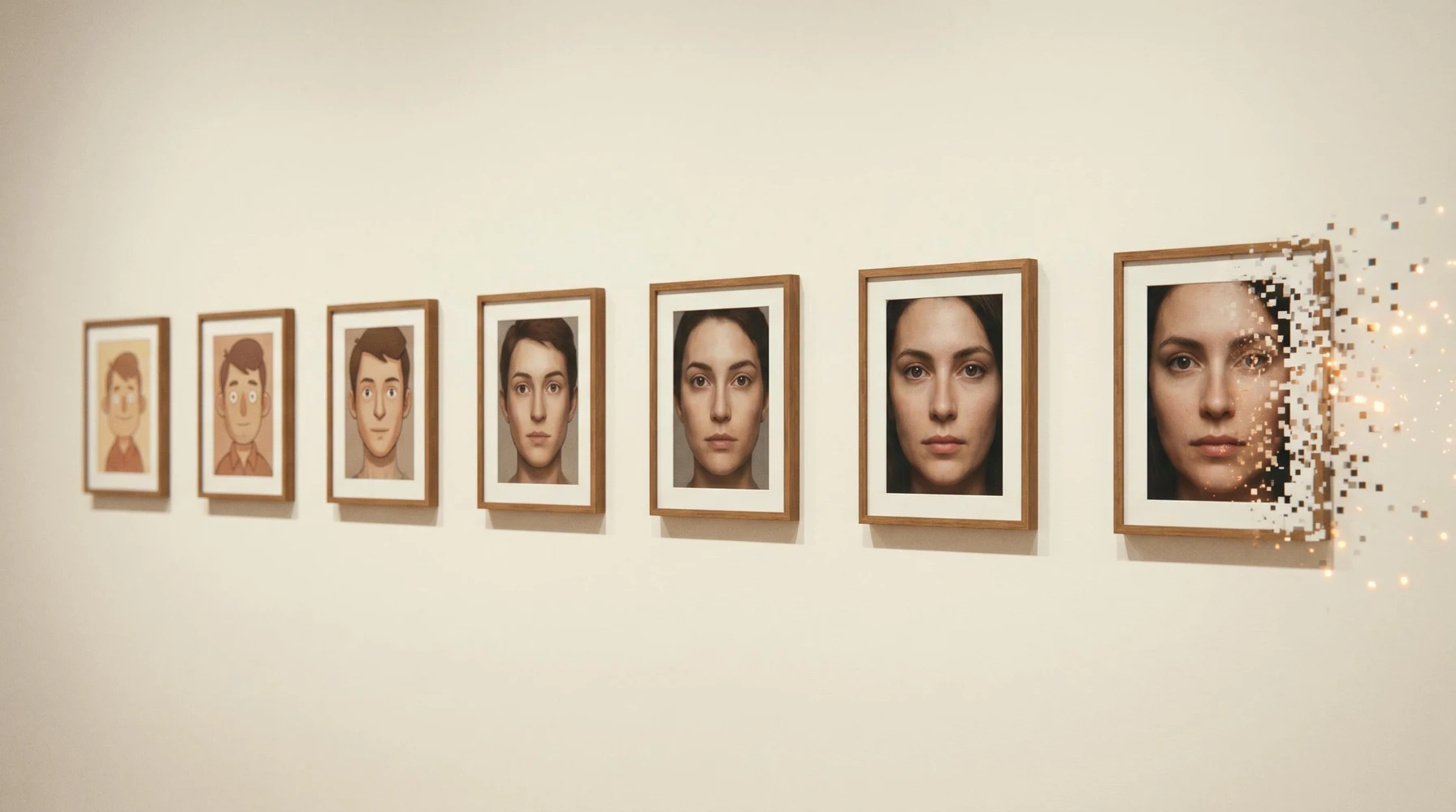
2007. Hatsune Miku. A Japanese Vocaloid character by Crypton Future Media — the first commercially successful fully artificial artist. Hologram concerts, album sales, merch. The “virtual artist” category was born here, before social networks in the modern sense.
2015. Any Malu (Brazil). An animated virtual character who grew out of YouTube. Reported at over 280M YouTube views, with a show of her own on Cartoon Network. The case shows that a non-photorealistic stylized character can scale through a strong personality, not through photorealism (Socially Powerful).
2016. Lil Miquela. Created by the studio Brud — the first commercially significant Instagram-native virtual influencer. More than 2 million followers on Instagram (August 2026); trade press has reported rates in the five-figure range per sponsored post, though no primary source publishes the rate. Brud raised $20–30M in January 2019 at a pre-money valuation of at least $125M, led by Spark Capital (TechCrunch, 14.01.2019), and was acquired by Dapper Labs in October 2021 in an all-equity deal with undisclosed terms (TechCrunch, 04.10.2021). Campaigns with Prada (Milan Fashion Week takeover 2018 — noted as a strong adoption signal, with no confirmed public engagement metric), Calvin Klein (2019, with Bella Hadid), Pacsun, Samsung (creative.salon).
2017. Shudu Gram. “The first digital supermodel,” by Cameron-James Wilson. The Balmain pre-fall 2018 “Virtual Army” campaign was the first time a major fashion house put a virtual model at the center of a campaign, not as an experiment. The project also drew sustained criticism — a white British photographer creating a Black digital model — and that debate is part of the case, not a footnote to it (BuzzFeed).
2018. Imma (Japan) and Noonoouri (Germany). Imma, by Aww Inc., is Japan’s leading fashion influencer; the IKEA Harajuku 2020 campaign (a 72-hour live stream from a physical storefront with LED panels), plus partnerships with Porsche, Coach, PUMA (Muse by Clios). Noonoouri, a virtual (CGI) persona hand-crafted by Joerg Zuber, has worked with Dior, Balenciaga, Valentino; in September 2023 she became the first strictly digital popstar to land a Warner Music record deal and released the track “Dominoes” (Hypebeast, September 2023).
2019. KFC virtual Colonel Sanders. The brand relaunched the mascot as a streetwear influencer — a widely covered Gen Z play with no published engagement metric (creative.salon).
2020. Rozy (South Korea). Sidus Studio X launched Korea’s first virtual influencer. By 2022 she had brought her creators roughly $2M in revenue; in her first year she was projected to earn close to $1M in sponsorships. Partnerships: Chevrolet, Calvin Klein, Hera (LG Household), dozens of local beauty brands. She released a music album and founded her own skincare brand, OHROZY (CNN, 30.07.2022).
2022. Kyra (India). Built by FUTR Studios and launched in 2022, she has modelled in brand campaigns and pitched herself on Shark Tank India, which cemented the category in Indian mainstream awareness (The Swaddle). We found no primary source for her follower count, for a specific brand list, or for the season she pitched in, so we don’t quote any of them.
2023. Aitana López (Spain). From The Clueless agency in Barcelona. Earnings up to €10,000/month, averaging €3,000, with a single ad rate just over €1,000, and 343,000+ followers in 18 months. Brand case: Big (sports nutrition) (Euronews, 27.12.2024). The agency was founded after the studio decided it no longer wanted to depend on other people, and against a backdrop of rising model costs (Fortune, 23.11.2023).
2024. BMW iX2 × Lil Miquela. The “Make It Real” campaign by the agency Monks — the first time a premium automaker gave a virtual character the lead role in a product launch, putting the iX2 in front of Miquela’s audience of more than 8.2 million. The campaign won 1 CLIO, 1 Epica, and 3 Lovie awards (Monks case study). Engagement figures circulating in trade posts for this campaign do not appear in any public primary source, so we don’t cite them.
2025. Mia Zelu. An AI-generated persona curated by an anonymous team, who gained 169,000 Instagram followers since March 2025 off “attending” Wimbledon 2025. Her Instagram posts were not labeled as AI-generated, and while her bio did read “digital storyteller & AI influencer,” that is a detail some users may easily overlook — the disclosure was there and still failed to land. The case was picked up by Northeastern’s D’Amore-McKim Business School (D’Amore-McKim) and UTS Sydney (UTS, 08.2025) as an illustration of digital trust erosion.
Geography shows the category is not local: the US (Miquela), Japan (Imma), Korea (Rozy), Germany (Noonoouri), Spain (Aitana), Brazil (Any Malu), India (Kyra), the UK (Shudu). That is a structural fact — an AI creator is technically untied to geo, unlike a human influencer who monetizes through a local market.
What market sits behind the category in 2026?
The global virtual influencer market is valued at $6.06B in 2024 with a forecast up to $45.88B by 2030 and a CAGR of 40.8% (Grand View Research, 2025 edition). Alternative estimates diverge by multiples, which is in itself a signal that the category is young and methodologies have not settled:
Table 1. Virtual influencer market estimates
| Analyst | Base estimate | Horizon | Forecast | CAGR |
|---|---|---|---|---|
| Grand View Research (2025 edition) | $6.06B (2024) | 2030 | $45.88B | 40.8% |
| Straits Research | $8.76B (2025) | 2034 | $163.20B | 38.4% |
| Market.us | $6.1B (2024) | 2034 | $170.2B | 39.5% |
| Market Research Future (2025 edition) | $12.83B (2025) | 2034 | $224.36B | 37.4% |
| SNS Insider | $6.9B (2023) | 2032 | $154.6B | 41.29% |
Sources: Grand View Research, Straits Research, Market.us, Market Research Future, SNS Insider.
The most likely explanation for the 2–5× spread across similar horizons — a hypothesis, not a settled fact — is that some analysts count “pure AI” characters while others count the entire stack (CGI avatars for metahuman campaigns, UGC avatars from HeyGen/Synthesia, AI tooling for tagging and discovery inside classic influencer marketing). In a marketer pitch, the safer citation is Grand View ($45B by 2030) as a conservative upper bound on the mainstream.
US influencer marketing spending is projected at $10.52B in 2025 (eMarketer, 13.03.2025) and $13.7B by 2027 (eMarketer, 23.06.2025). Against that backdrop, Ogilvy’s “Future of Social” report (March 2024) projects that virtual influencers could account for up to 30% of influencer budgets by 2026 (Mediaweek, 26.03.2024) — an upper-bound scenario, not a committed forecast. (This projection circulates online misattributed to Gartner; we could not find any Gartner publication behind it. The source is Ogilvy.)
Why are brands buying AI creators right now?
Four pressures aligned in phase between 2023 and 2026 — and together they moved the category from experimental to operational.
The technology turned operational
Through 2023–2025, generative video moved out of demo mode into production tooling. Veo 3.1 (Google), Kling 3.0 (Kuaishou), and Runway Gen-4.5 all ship public APIs. Per-second generation cost differs by model tier; the figures for the Cifratar pipeline are internal production data and we don’t quote them here. The tool layer itself churns — OpenAI’s Sora 2 was discontinued as a consumer product on April 26, 2026, with the API sunsetting on September 24, 2026 (OpenAI Help Center) — but the pipeline logic persists regardless of which model sits in each slot. ElevenLabs offers multilingual synthesis in dozens of languages, at $22/mo on the Creator plan ($11 for the first month) (ElevenLabs). That makes localization across markets roughly two orders of magnitude cheaper than a human localization team. We break the full stack down in a companion guide to the AI-native advertising pipeline.
Control and predictability
A virtual character won’t run into a scandal, post a political opinion, miss a deadline, or get more expensive after going viral. That’s close to the reason The Clueless gave when launching Aitana López: the studio said it wanted to stop being dependent on other people, and pointed at rising costs (Fortune). From a brand manager’s view this isn’t a rejection of the human factor — it’s swapping one class of risk (human behavior) for another (the narrative the managers write), and the second class is process-manageable.
The engagement gap
HypeAuditor’s November 2019 Instagram analysis reported roughly 3× higher engagement for virtual influencers, and HypeAuditor’s 2021 follow-up repeated the “almost three times higher” finding. The tier-level percentages behind that headline survive only in a tertiary retelling (WeRSM — a third-party summary, not a primary source), and HypeAuditor has never republished them. No public primary source confirms updated figures for 2024–2025. Use 3× as a narrative anchor, not a precise metric.
In trust-sensitive verticals (parenting, finance, health), our working hypothesis is that the advantage flips toward humans — audiences there need parasocial trust, which a virtual character delivers worse (consistent with the academic findings below). We have not found a reliable public number for the size of that flip, so we won’t quote one. For the marketer the takeaway is: an AI creator is not “always better.” It has its own efficiency curve across the funnel and across verticals.
What does the academic literature say?
The category is mature enough to have its own empirical field. A bibliometric review — “Mapping the rise of virtual influencers: A bibliometric analysis,” Telecommunications Policy 49(10), 2025, DOI 10.1016/j.telpol.2025.103071 — tracks sustained year-over-year growth in publications on the topic.
A systematic literature review in Acta Psychologica (2025), titled “Authenticity, ethics, and transparency in virtual influencer marketing” (Khalfallah & Keller, vol. 260, art. 105573), frames the field around trust, disclosure, and culture in its VITEM model (Acta Psychologica). The much-quoted framing of virtual influencers as “authentically fake” — audiences accepting them precisely in that status — belongs to a different study: Lou et al., Journal of Advertising (2023). Curated flaws (programmed biographical “imperfections”) and self-justification (open acknowledgment of AI nature) are the levers this literature associates with softening the uncanny-valley effect.
Wiley’s Psychology & Marketing (Gutuleac, 2024) reports a counterintuitive result: highly anthropomorphized virtual influencers may elicit a greater sense of uncanniness than less anthropomorphized ones — with a moderator the headline usually drops: in the presence of social cues, the influence of anthropomorphism on uncanniness is attenuated (Wiley).
For the marketer, the practical read is this: the race for photorealism can work against the brand in trust-sensitive verticals. A stylized character (in the Noonoouri or Any Malu mode) can be strategically better in categories where the audience needs to “forgive” the artificial. That’s a design lever worth holding consciously, not as a consequence of technical limits.
Regulatory context 2026
By the end of 2026, watermarking and disclosure become mandatory in every major market, and that moves “marking AI content” from best practice into compliance.
- YouTube. Disclosure mandatory since March 2024; YouTube has signalled future enforcement measures without naming a date (YouTube Blog).
- Meta (Facebook/Instagram/Threads). “Made with AI” labels from May 2024, renamed “AI info” in July 2024 (Meta, 04.2024); detection leans on C2PA markers, which Meta describes in a separate post (Meta, 06.02.2024).
- TikTok. C2PA since May 2024 — the first video sharing platform to put Content Credentials into practice (TikTok Newsroom, 09.05.2024). TikTok says it had labeled more than 3 billion videos as AI-generated content as of July 2026 (TikTok Newsroom, 10.07.2026).
- FTC. Endorsement rules apply to virtual endorsers the same as to humans, plus the endorser’s non-human nature must be disclosed. The 2024 Rule on Consumer Reviews and Testimonials (16 CFR Part 465) explicitly covers AI-generated fake reviews and fake indicators of social media influence (FTC, 14.08.2024). Civil penalties run up to $53,088 per violation as of the 2025 inflation adjustment (Federal Register, 17.01.2025); the figure at the rule’s October 2024 enactment was $51,744.
- EU AI Act Article 50. Transparency obligations under Article 50 apply from 2 August 2026 (artificialintelligenceact.eu).
The practical takeaway: not labeling by the end of 2026 is an active choice of risk, not a passive time saving. For a brand, it’s cheaper to wire C2PA and SynthID into the production pipeline from day one than to rebuild the stack after the first fine. How platform detection actually treats AI content is a topic of its own — we cover it in Platform algorithms and AI content.
Where does it work, and where doesn’t it?
To avoid buying the category as a “universal solution,” it helps to fix up front where its strength and weakness sit on the funnel.
Works (top-funnel awareness and engagement): fashion, lifestyle, entertainment, tech, beauty, food. The Aitana, Imma, Rozy, and KFC cases all show a steady engagement gap in favor of virtuals.
Parity (mid-funnel consideration): B2B SaaS, retail, automotive. BMW iX2 × Lil Miquela is the indicative case: a premium brand earns relevant impressions, but direct conversion still needs a second touch.
Weaker than humans (bottom-funnel conversion in trust-sensitive verticals): parenting, finance, health. Here audiences need parasocial trust, which a virtual character still delivers worse — our working hypothesis, consistent with the academic findings on trust.
For the brand the takeaway is: an AI creator is not a replacement for the existing pool of human influencers — it’s a different tool in the portfolio. Top-funnel and brand-building on AI, performance bridge on humans, mid-funnel wherever the economics works out.
Frequently asked questions
How is an AI creator different from a regular avatar in HeyGen or Synthesia?
A stock avatar from HeyGen or Synthesia is “a face without a personality”: a set of photorealistic models you can use to voice over any script. An AI creator is a character with a biography, a consistent visual style, a vocal identity, and a posting history, who has an audience. One is used as a production tool; the other is a media asset with its own capital value.
Is it legal to run ads from an AI character?
Yes, with explicit disclosure. The FTC, EU AI Act Article 50, YouTube, Meta, and TikTok all require labeling AI nature — somewhere via a toggle at publish, somewhere via C2PA metadata. Hiding the AI nature is prohibited: FTC civil penalties run up to $53,088 per violation (2025 figure), on top of platform sanctions.
How much does it cost to launch your own AI creator?
It depends on the stack. A 2D character on a generative pipeline is the cheap end: a setup fee plus a monthly operating budget. Agency-grade metahuman production on Unreal Engine sits far higher. We do not publish exact per-channel figures for the Cifratar pipeline.
In which verticals is the AI creator already working, and where isn’t it yet?
See the “Where does it work, and where doesn’t it?” section above for the full breakdown. Short version: works in fashion, lifestyle, entertainment, tech, beauty, food; parity in B2B SaaS, retail, automotive; weaker in parenting, finance, health — categories where, on our working hypothesis, the audience needs parasocial trust and empathy.
Does the audience really believe an AI influencer is a “real person”?
No, and that’s no longer the goal. Current research finds that audiences accept the AI character precisely as “authentically fake” — sincerely-fake, if openly declared as such. Curated flaws (biographical imperfections) strengthen engagement. And a disclosure that exists but is easy to miss does not settle the question: Mia Zelu’s bio read “digital storyteller & AI influencer” while her Wimbledon 2025 posts carried no AI label, and the case is now cited as an illustration of digital trust erosion.
What replaces a human influencer if the budget is capped at $5k?
With $5k you can either buy 1–2 posts from a mid-tier micro influencer (rates for that tier typically run in the low four figures per post), or launch your own AI creator on a 2D stack, where a first-month budget of the same order covers setup plus operations and produces a content stream instead of two posts. The decision turns on whether you need a one-time reach spike or a systemic channel for 6+ months.
What changes on the 2026–2027 horizon?
Three trends. Auto-detection of AI content becomes the default on every major platform (TikTok says it had labeled more than 3 billion videos as AI-generated content as of July 2026). Watermarking is embedded into tools at the model level (Google’s SynthID adds an invisible digital watermark to an AI-generated image or video segment, per Google DeepMind). The category shifts from explaining “what it is” to selling “how it’s measured” — the client expects unit economics and cases, not an intro to the technology.
What should a brand do next week?
Before launching: lock in the vertical your brand operates in and check against the table above which funnel zone it lands in. If it’s in “works” — the next useful step is to look at how a “channel factory” unit economics compares against the standard “one character — one project” model — we cover that comparison in a companion piece. If it’s in “weaker” — the category isn’t closed off, but it requires a stylized approach and a realistic KPI bar.
Further reading:
- Platform algorithms and AI content
- How to choose an influencer in 2026: 7-step framework
- The AI-native advertising pipeline: from brief to publication
Tell us about your business
Takes 2 minutes. We'll find the right creator and send you a proposal within 24 hours.
Who are you?
Tell us about your business
Takes 2 minutes. We'll find the right creator and send you a proposal within 24 hours.
Who are you?